Building a Minimum Viable Product (MVP) as a solopreneur often feels like a race against time and resources. Traditional user research is frequently the first thing to be cut from the budget, yet skipping it is a primary reason why many startups fail to find product-market fit. By integrating an AI-powered research MVP solopreneur workflow, you can validate your assumptions, understand your target audience, and prioritise your build with professional rigour without needing a full research department.
As a solopreneur, you do not need to choose between moving fast and being evidence-based. Technological tools now act as sophisticated assistants that support your human craft, enabling you to automate the heavy lifting of data gathering and synthesis. This guide outlines a practical, five-step framework to help you run ethical, AI-supported research that ensures your MVP solves a real problem for real people.
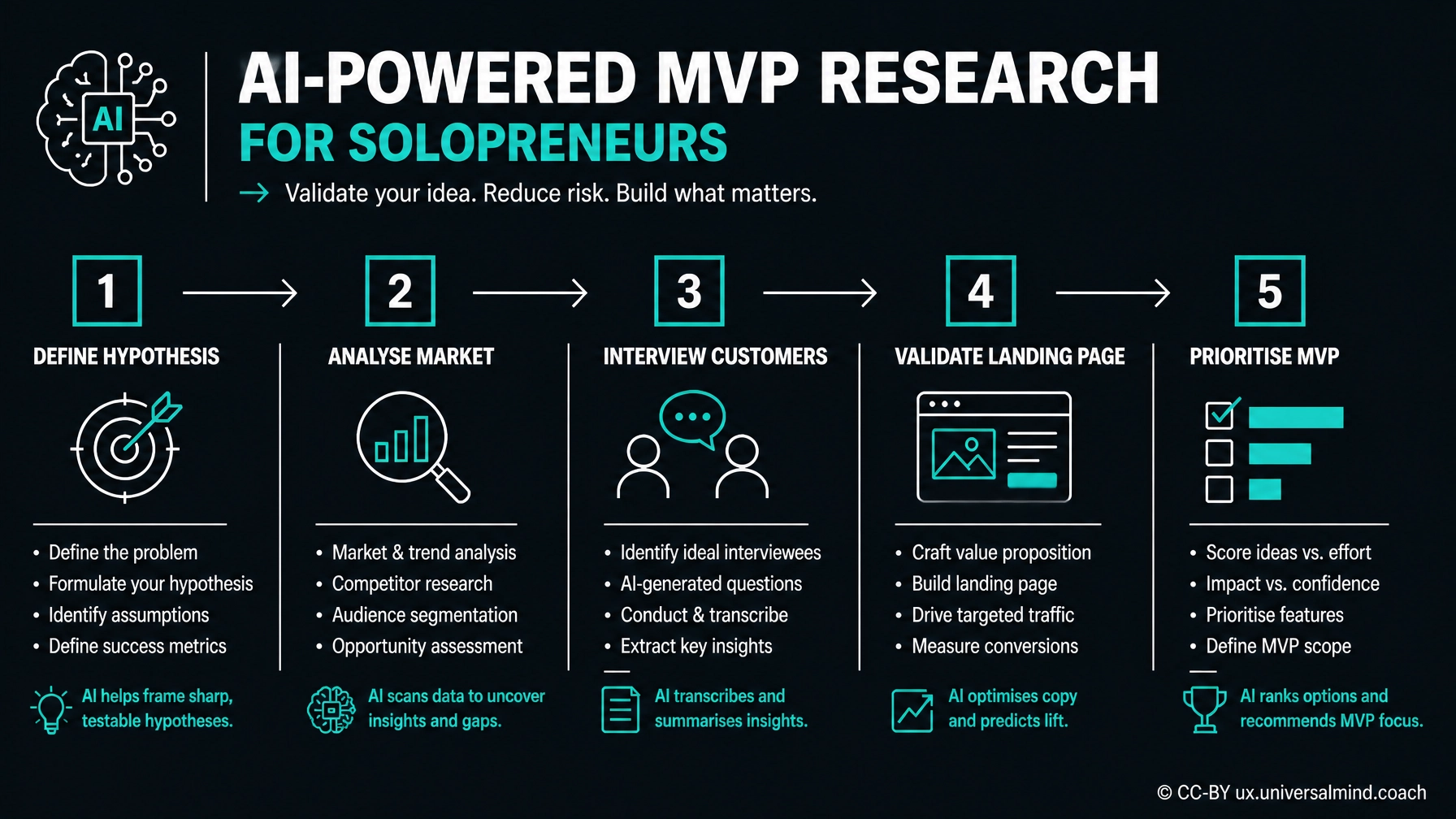
Five-step AI-powered MVP research process
Step 1: Define Your Hypothesis with AI as a Thinking Partner
The foundation of any successful MVP is a clear, testable hypothesis. Many founders start with a solution in mind rather than a problem to solve. Before you write a single line of code or design a landing page, you must articulate exactly what pain point you are addressing and for whom.
Using AI as a thinking partner at this stage helps you stress-test your logic. Rather than asking a chatbot to "give me business ideas," use it to analyse the coherence of your existing concept. You can prompt an AI assistant to act as a "devil’s advocate" or a "lean startup expert" to identify gaps in your reasoning.
Ask yourself:
- What is the specific, measurable problem?
- Who is the primary user experiencing this?
- What is the current, imperfect way they solve it?
- What is the single most important metric for success?
By documenting these assumptions in a structured workspace like the AI Customer Research Hub, you create a single source of truth that evolves as you gather data. This prevents "founder's amnesia," where you subconsciously shift your goals to match your results.
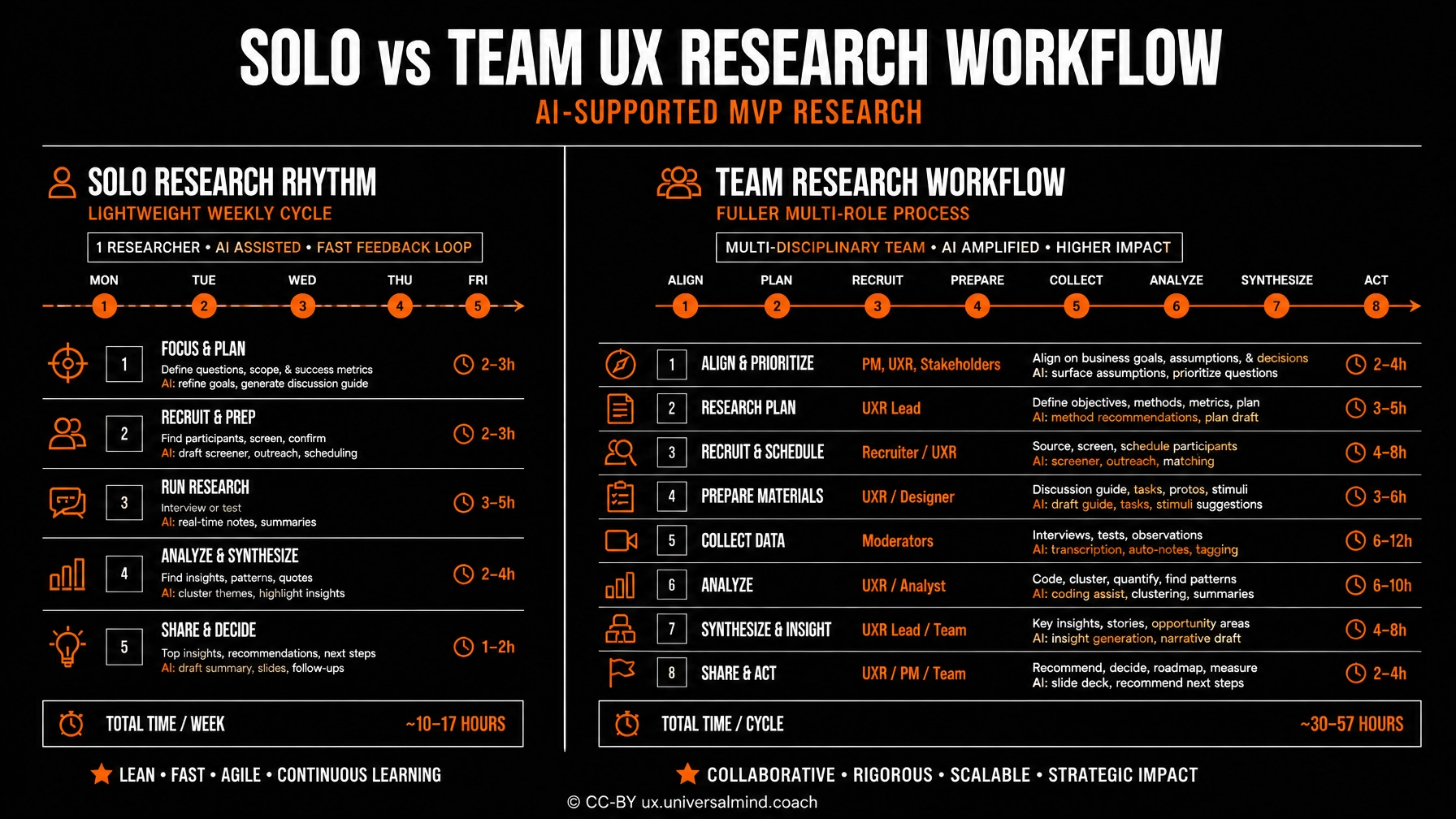
Solo research rhythm vs. team research workflow
Step 2: Conduct High-Speed Market and Competitor Analysis
Once your hypothesis is set, you need to understand the landscape. In the past, market research required weeks of manual searching through forums, reviews, and industry reports. AI-powered tools can now aggregate and synthesise this information in a fraction of the time.
To augment your market analysis, use AI to:
- Analyse User Reviews: Feed transcripts or scraped reviews of competitor products into an AI to identify recurring complaints and unmet needs.
- Identify Alternatives: Ask AI to identify "non-obvious" competitors: how are people solving this problem using spreadsheets, manual hacks, or unrelated software?
- Synthesise Industry Trends: Use tools with web-browsing capabilities to summarise the latest shifts in your specific niche.
The goal here is not to find a gap in the market, but to find a market in the gap. You are looking for evidence that the problem is painful enough that people are already trying (and failing) to solve it. This stage provides the necessary context to ensure your AI-powered research MVP solopreneur strategy is grounded in market reality, not just intuition.
Step 3: Run AI-Assisted Customer Discovery Interviews
The most critical part of validation is talking to humans. AI cannot replace the nuance of a real customer conversation, but it can significantly accelerate the preparation and analysis phases.
Many solopreneurs struggle with "moderator bias": asking leading questions that encourage the participant to agree with them. You can use AI to review your interview script for neutral language and "question hygiene." Once your interviews are complete, the real work begins: synthesis.
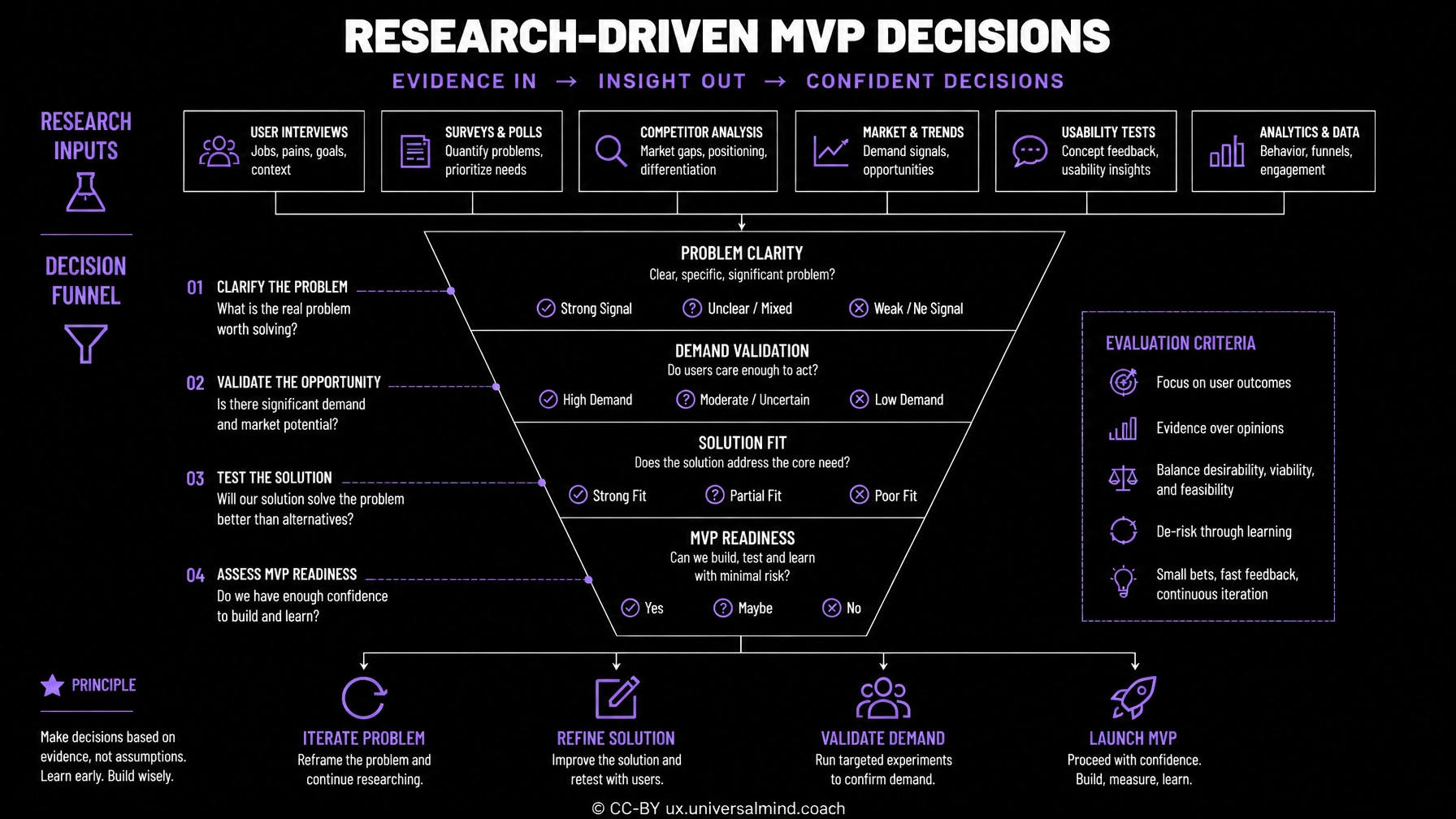
Research-driven decision funnel for MVP
Instead of spending hours transcribing and coding themes manually, you can use AI to:
- Extract Key Quotes: Automatically identify the most impactful "verbatims" that describe the user's pain points.
- Identify Patterns: Cluster insights across multiple interviews to see which problems are universal and which are edge cases.
- Create Evidence-Based Personas: Use real interview data to build personas that reflect actual human behaviour, rather than idealistic archetypes.
For a structured approach to this, our 5-Day Sprint Kit provides specific prompt patterns and Notion templates designed to move you from raw notes to a prioritised report in under a week.

Step 4: Validate Interest with an AI-Optimised Landing Page
Before you build the full MVP, you need a "smoke test." A landing page is a low-fidelity way to measure real-world interest. The challenge for solo founders is often copywriting and design: tasks that can take weeks to perfect.
AI can support this by generating multiple value propositions based on the insights you gathered in Step 3. You can use these tools to draft headlines, benefit bullets, and calls-to-action (CTAs) tailored to the specific language your interviewees used.
A successful validation page should:
- State the problem clearly.
- Present your solution as the primary fix.
- Include a "hard" conversion metric, such as an email sign-up for early access or a pre-order button.
By running small, targeted ad campaigns or sharing the link in relevant communities, you gather quantitative data to back up your qualitative findings. If people are unwilling to leave an email address for your solution now, they are unlikely to pay for it later.
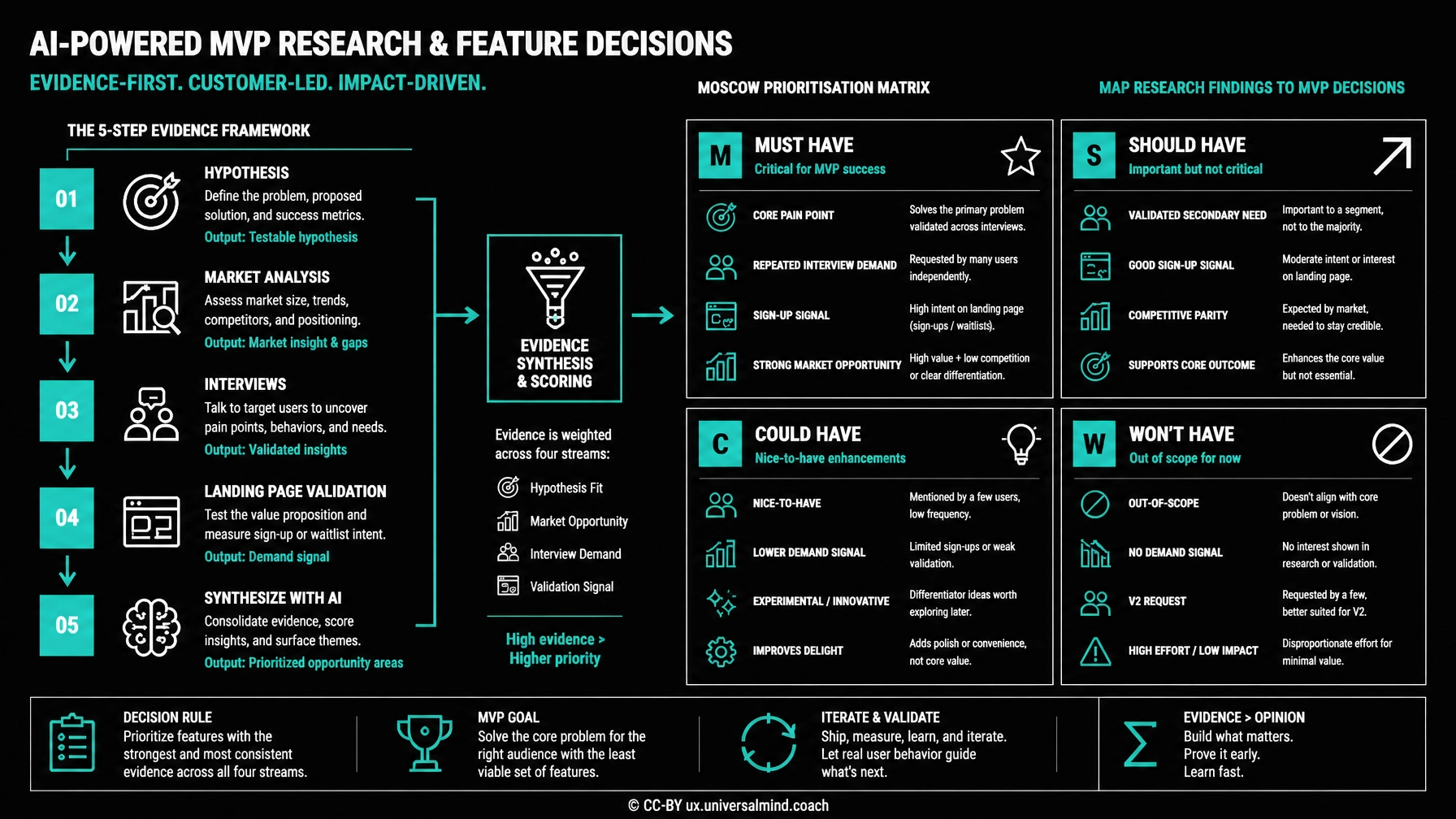
MoSCoW prioritisation matrix for MVP features
Step 5: Prioritise Your MVP Features Using AI Synthesis
The most common trap for solopreneurs is "feature creep." You want to solve everything at once, which leads to a bloated product that takes too long to ship. Use the data you have gathered to ruthlessly prioritise.
AI can help you map your research findings to a feature list. By inputting your "Opportunity Solution Tree"—a framework that links user problems to potential solutions—you can ask an AI assistant to help you identify the "Minimum" in Minimum Viable Product.
Ask the AI to help you categorise features using the MoSCoW method (Must have, Should have, Could have, Won't have):
- Must Have: The features that directly address the core pain point identified in Step 3.
- Should Have: Important features that can wait for V2.
- Could Have: Nice-to-haves that add polish but don't validate the core hypothesis.
This objective analysis helps you stay disciplined. It ensures that the first version of your product is a focused tool that provides immediate value, allowing you to enter the market quickly and begin the cycle of continuous discovery.
Moving from Research to Launch
Integrating AI into your workflow isn't about replacing the human element of UX; it is about augmenting your capacity to handle complex data as a team of one. By following this AI-powered research MVP solopreneur guide, you move from "guessing and building" to "researching and shipping."
If you want a practical next step, start with the 5-Day Sprint Kit to structure your first round of research. When you need a more robust system for storing notes, prompts, and synthesis, move into the AI Customer Research Hub. From there, Pascal Raabe’s Udemy courses can help you deepen your workflow, The Research Lab offers ongoing peer support, and consulting is there for teams that need direct hands-on help.
Professional research is no longer a luxury reserved for enterprise teams. With the right frameworks and a pragmatic approach to AI, you can launch your MVP with the confidence that you are solving a problem worth solving.
Key Takeaways for Solopreneurs
- AI is an assistant, not a replacement: Use it to synthesise and organise, but always maintain human oversight of the final decisions.
- Stay lean: Focus on one core problem and one core solution for your MVP.
- Document everything: Use a centralised workspace to ensure your research stays actionable and organised.
- Validate early: A landing page can save you months of wasted development time.