To integrate AI-moderated interviews with your UX workflow effectively, you must position them as a scalable layer for structured, high-volume discovery rather than a total replacement for human-led research. This integration involves mapping specific recurring research needs—such as churn analysis or onboarding check-ins—to AI moderators that use adaptive probing logic. By defining clear "guardrail prompts" and feeding the resulting structured transcripts into a central synthesis hub, you can augment your discovery capacity without compromising the qualitative rigour your product decisions require.
The human-plus-AI interview moderation loop.
Defining the Role of AI Moderation in Your Stack
In the current landscape of product development, the pressure to "move fast" often leads to skipped research. Integrating AI-moderated interviews offers a pragmatic middle ground. However, it is essential to distinguish where these tools provide value and where they introduce risk.
AI moderators are best suited for repeatable, semi-structured research. Think of these as the "why" behind your quantitative data. If your analytics show a drop-off in a specific user flow, an AI-moderated study can talk to fifty users in the time it takes you to recruit for one human session.
Conversely, foundational discovery—uncovering entirely new mental models or exploring sensitive emotional drivers—remains the domain of the human researcher. Use AI to handle the "continuous" part of discovery, freeing your schedule for the "deep" part.
When to Use AI-Moderated Interviews
- Onboarding Diagnostics: Assessing first-time user experience at scale.
- Feature Gap Analysis: Gathering feedback on a specific new release.
- Churn & Win/Loss Interviews: Automating the collection of "reasons why" after a subscription change.
- Survey Augmentation: Replacing open-ended text boxes with 5-minute AI conversations.
Preparing Your Discussion Guide for AI Consumption
The success of your integration depends on how you translate your research objectives into instructions for the AI. Unlike a human moderator who can sense nuance and pivot based on intuition, an AI requires explicit logic. You are essentially building a "program" for a conversation.
The Single-Topic Rule
AI moderators perform best when questions are modular and single-topic. Avoid "double-barrelled" questions such as, "How did you find the checkout process and what would you change about the payment options?"
Instead, break these into two distinct prompts. This ensures the AI can accurately identify when a user has answered the specific point and whether it needs to probe deeper before moving on.
Adaptive Probing Logic
One of the most significant advantages of modern AI moderation is the ability to ask follow-up questions. To make this work in your workflow, you must define the "depth" of the probe. In my experience, limiting the AI to two follow-ups per core question prevents "circular questioning" where the AI bores the participant by asking for more detail on a trivial point.
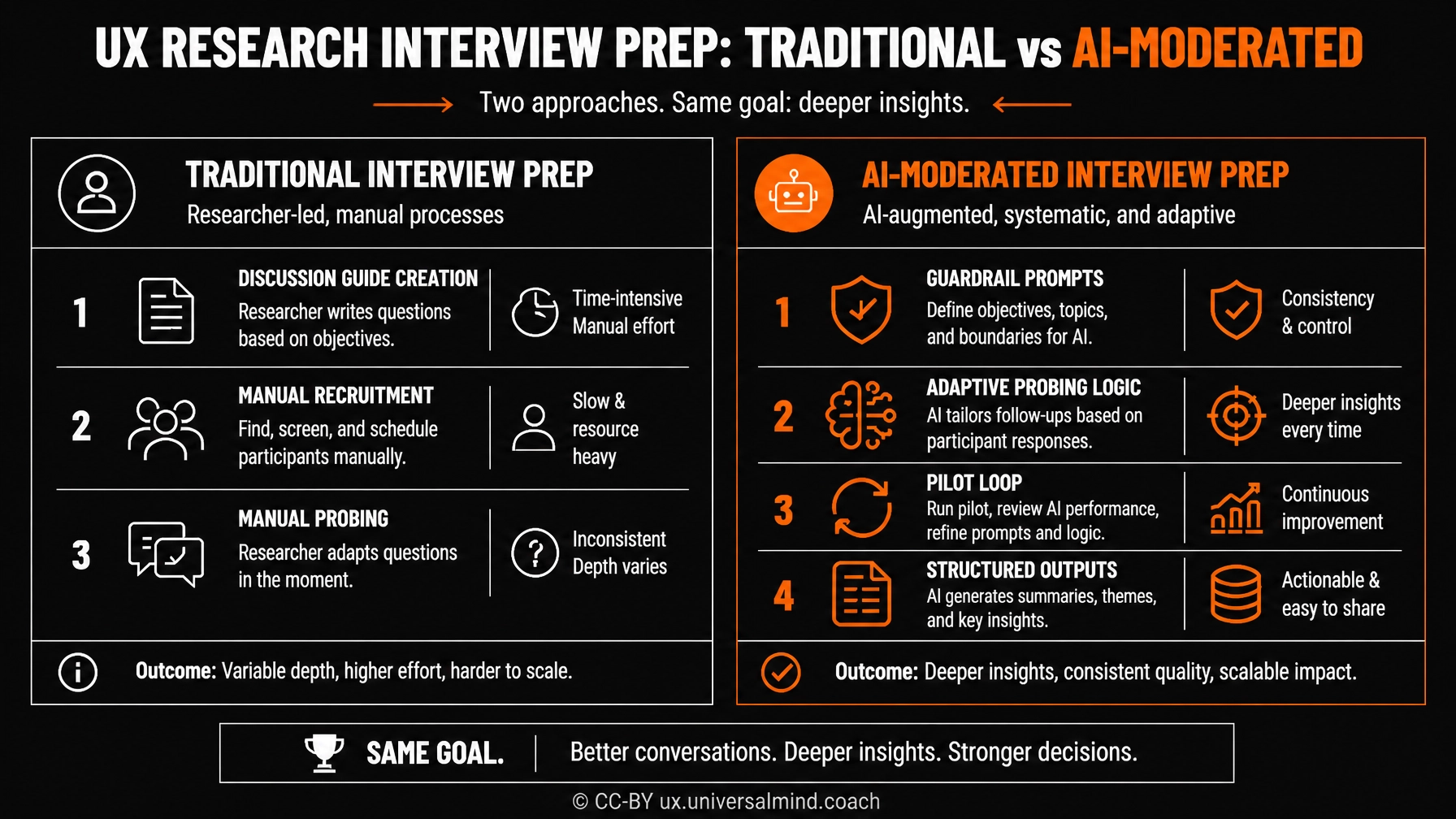
Traditional interview prep vs. AI-moderated prep
A Step-by-Step Integration Workflow
Integrating these tools isn't just about the interview itself; it's about the data flow before and after the session. Here is the workflow I recommend for teams looking to maintain high standards of rigour.
1. Scripting and "Guardrail" Configuration
Define your persona. Do not just let the AI be a generic bot. Instruct it to be a "Product Researcher" that is "curious yet neutral." You must also define "Completion Conditions": when the AI should stop asking and end the interview.
2. The Pilot Loop
Never launch an AI-moderated study to 100 people without a pilot. Run the interview yourself first, then run it with three colleagues. Look for areas where the AI gets stuck in a loop or fails to understand common industry jargon related to your product.
3. Deployment and Recruitment
Integrate the interview link directly into your product or email automation. For example, trigger an AI interview invite three days after a user tries a new "Beta" feature. This ensures the experience is fresh in their mind.
4. Synthesis and Analysis
This is where many researchers fail. They let the AI run the interview, then let another AI summarise it, and then they just read the summary. This is a recipe for "hallucinated insights."
Instead, use a structured framework like the AI Customer Research Hub to house your transcripts. The integration should allow you to see the "Raw Data" alongside the "AI Synthesis," allowing you to verify claims with a single click.
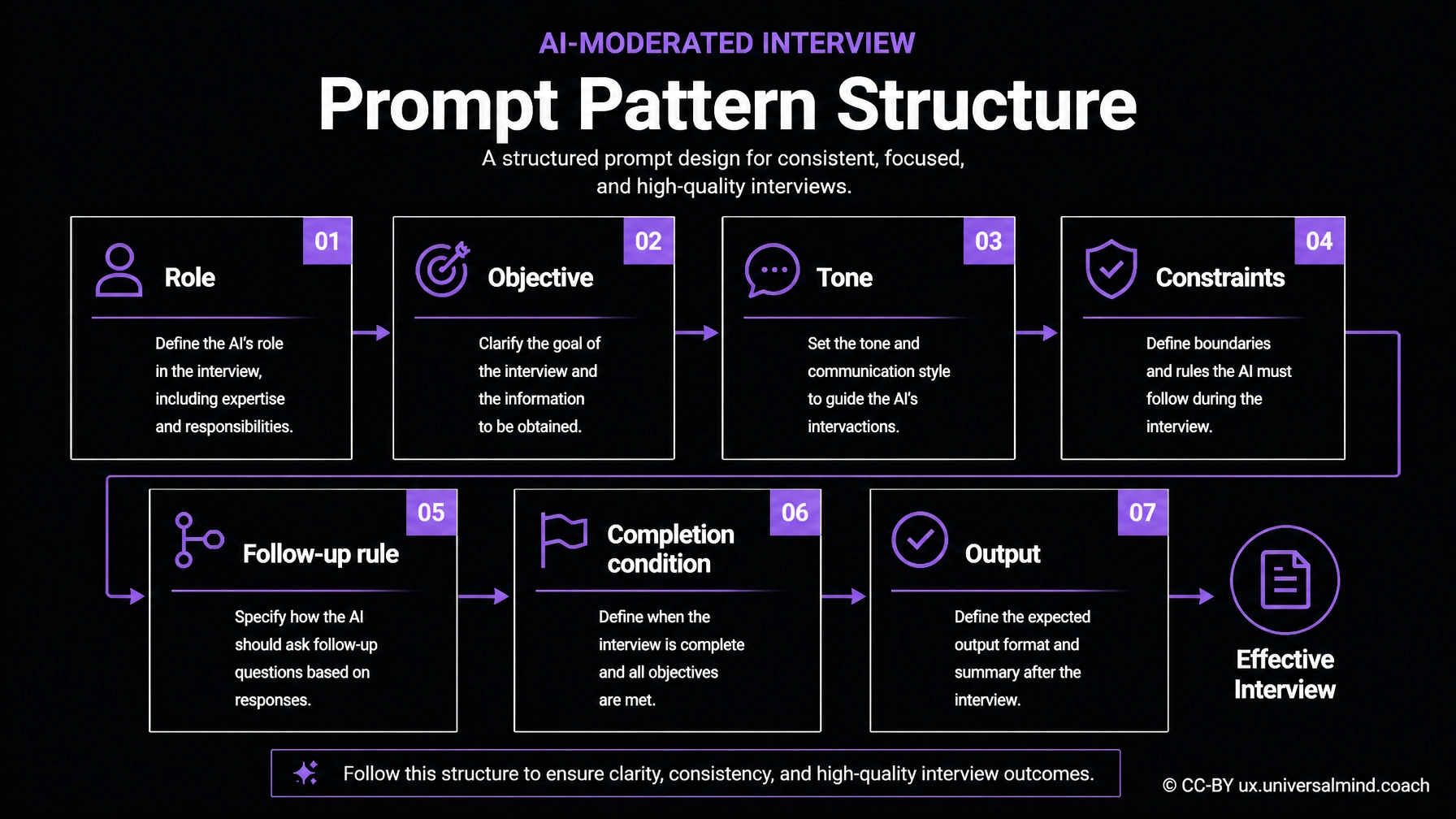
Prompt pattern structure for AI-moderated interviews
Reusable Prompt Patterns for AI Moderators
To help you get started, here are the prompt patterns I use when configuring moderators. These are designed to be "tool-agnostic" and can be adapted for most AI interview platforms or custom GPT setups.
The System Persona Prompt
Role: You are a professional UX Research Moderator.
Objective: Conduct a 15-minute interview about [Topic].
Tone: Practical, neutral, and encouraging.
Constraint 1: Ask only ONE question at a time.
Constraint 2: If the user provides a brief answer (under 10 words), ask ONE neutral follow-up like "Can you tell me more about that experience?"
Constraint 3: Do not use marketing hype or lead the user.
The "Story-Getter" Prompt
If you need qualitative depth, you must explicitly ask for stories.
"Instead of asking 'Do you like the dashboard?', ask 'Tell me about the last time you used the dashboard to find specific data. Walk me through exactly what you did.'"
Managing Synthesis and Rigour
The real work begins after the interviews are complete. When you integrate AI-moderated interviews with UX workflow, you are dealing with a volume of data that can quickly become overwhelming.
I suggest using a "Checklist for Synthesis" to ensure you aren't just accepting the AI's first draft of the findings. You should look for:
- Conflict check: Did two participants say the opposite thing? How did the AI handle that?
- Quote verification: Are the "Key Quotes" in the summary actually in the transcript?
- Outlier detection: Did the AI ignore a unique but critical pain point because it only happened once?
For those looking to accelerate this entire process—from planning to report—the 5-Day Sprint Kit provides a day-by-day structure that integrates these AI steps into a professional UX timeframe.
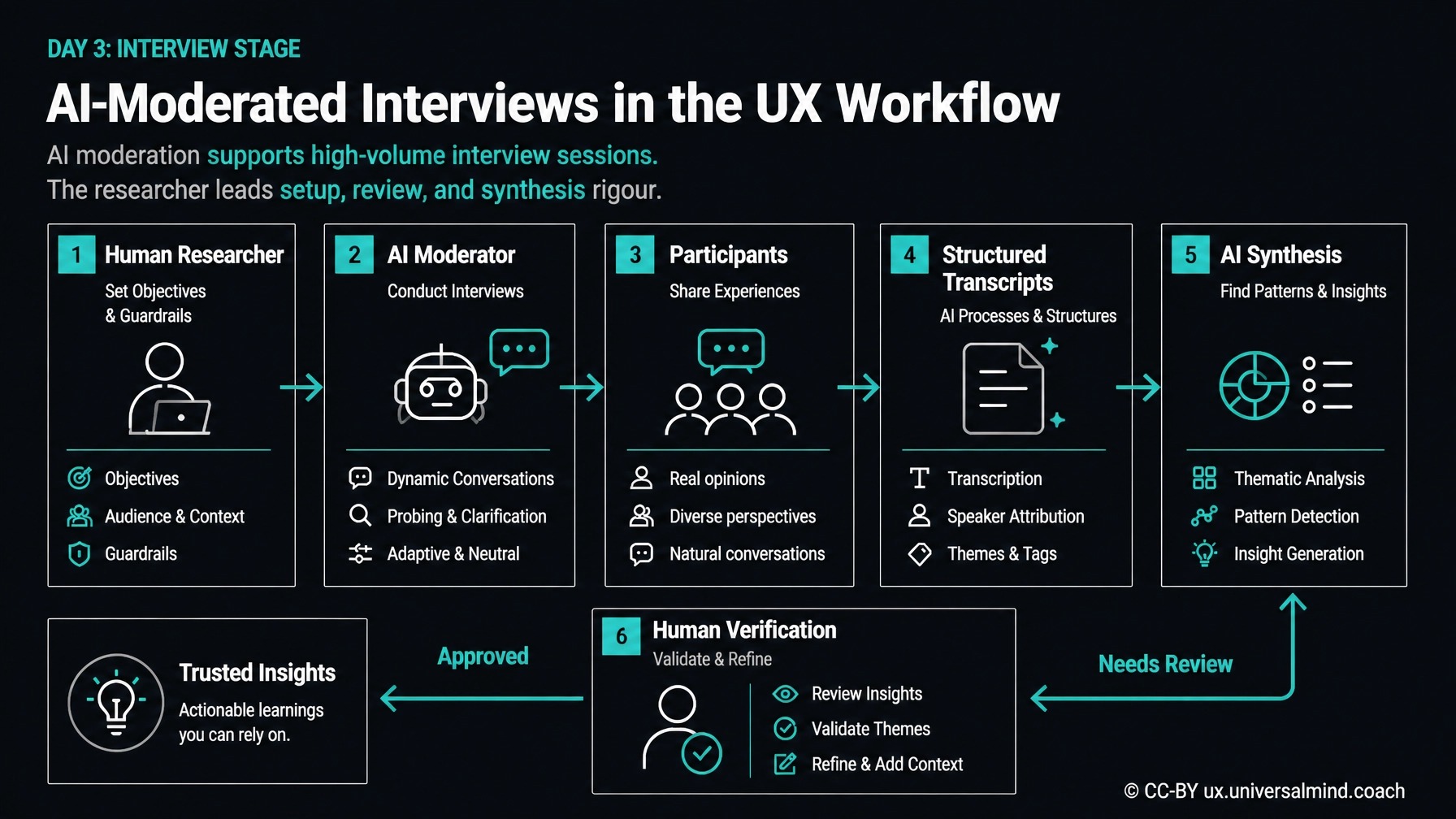
AI moderation supports high-volume interview sessions
Ethical Guardrails and Disclosure
Integrity is the foundation of UX research. When using AI moderators, you must be transparent.
- Explicit Disclosure: Always state: "I am an AI assistant helping the research team."
- The "Human Escape": Provide a way for the participant to leave a message for a human if they feel the AI isn't understanding them.
- Data Privacy: Ensure your chosen platform is GDPR/CCPA compliant and that participant data isn't being used to train public models without consent.
Augmentation, Not Replacement
Learning to integrate AI-moderated interviews with UX workflow is about expanding your reach. It allows you to be "always on" in your discovery, catching insights that would otherwise be lost to time and resource constraints.
By treating the AI as a junior assistant that needs clear instructions and human oversight, you can maintain the quality of your research while significantly increasing the volume of evidence supporting your product decisions.
If you are ready to move beyond basic prompting and build a professional, AI-supported research practice, consider joining our community at The Research Lab or enrolling in my AI & ChatGPT for UX Research course. We focus on the practical, no-hype application of these tools to help you build better products.
Author: Pascal Raabe