Continuous AI discovery is the practice of integrating automated synthesis into an ongoing user research pipeline to maintain a constant pulse on customer needs. Rather than running isolated, episodic research projects, product teams use AI to cluster feedback, identify emerging themes, and surface contradictions in real time. This guide explains how to set up a practical, evidence-based continuous AI discovery workflow so your team can learn faster, review signals with proper rigour, and make better product decisions without handing judgement over to the machine.
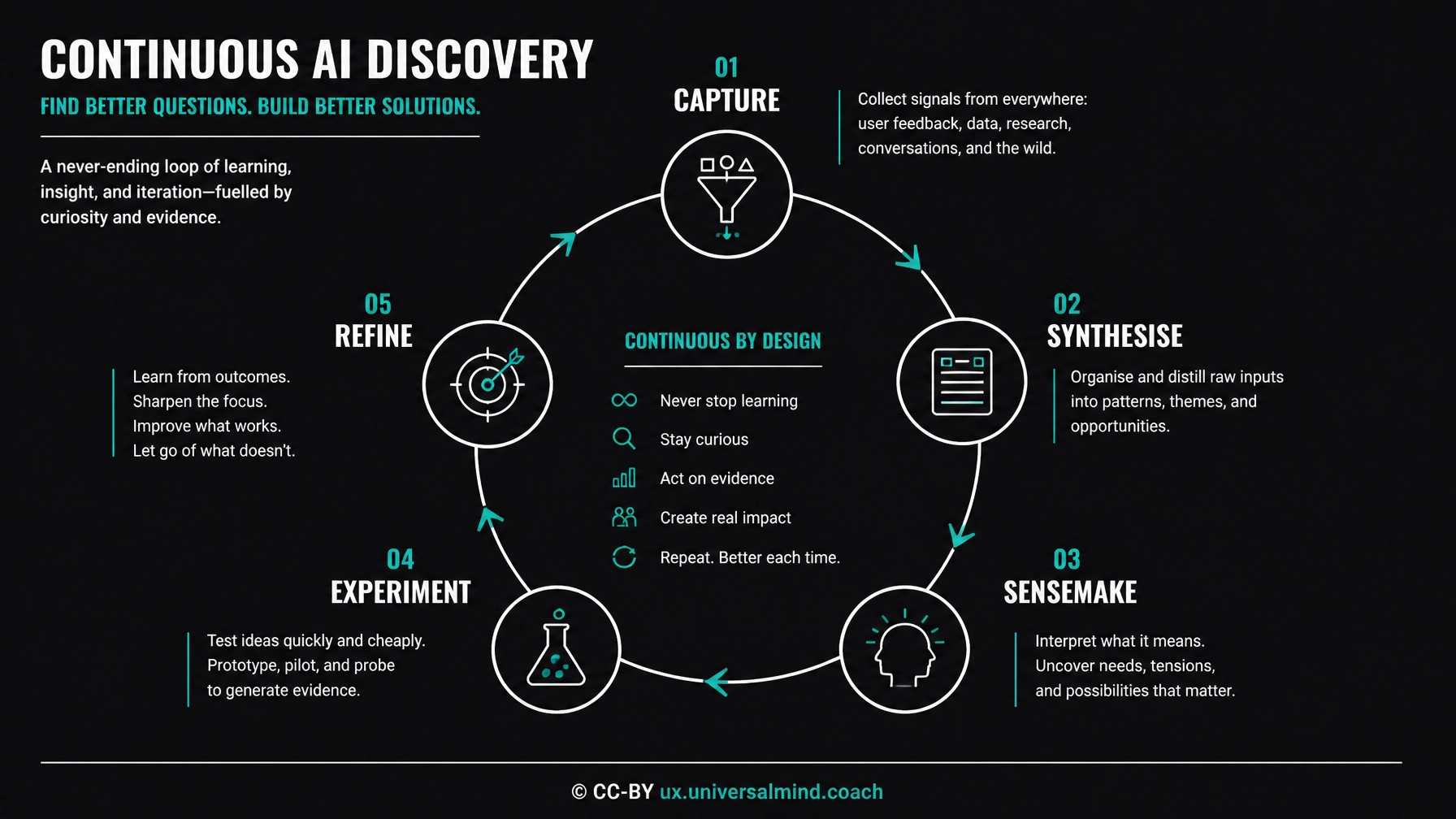
The Continuous AI Discovery Loop
The Shift from Projects to Pipelines
For years, UX research has been hampered by its own linear nature. We would identify a problem, recruit participants, conduct interviews, and spend weeks synthesising findings. By the time the report was published, the market had often moved on.
In the age of AI, this episodic model is becoming obsolete. We are moving towards a "pipeline" model where data flows into a central hub and AI acts as a 24/7 research assistant. This shift allows us to move from "What do we need to learn this month?" to "What is the evidence telling us right now?"
However, let’s be clear: continuous AI discovery is not about using "synthetic users" or AI-generated personas to replace real people. It is about using AI to augment the human ability to process vast amounts of qualitative data with speed and precision.
Step 1: Centralising Your Insights Hub
The foundation of a continuous discovery process is a robust repository. If your data is scattered across Slack, Zoom, and various Google Docs, your AI assistant cannot see the full picture.
I recommend using a centralised workspace like the AI Customer Research Hub built in Notion. This serves as your single source of truth where every interview transcript, support ticket, and usability test result is stored.
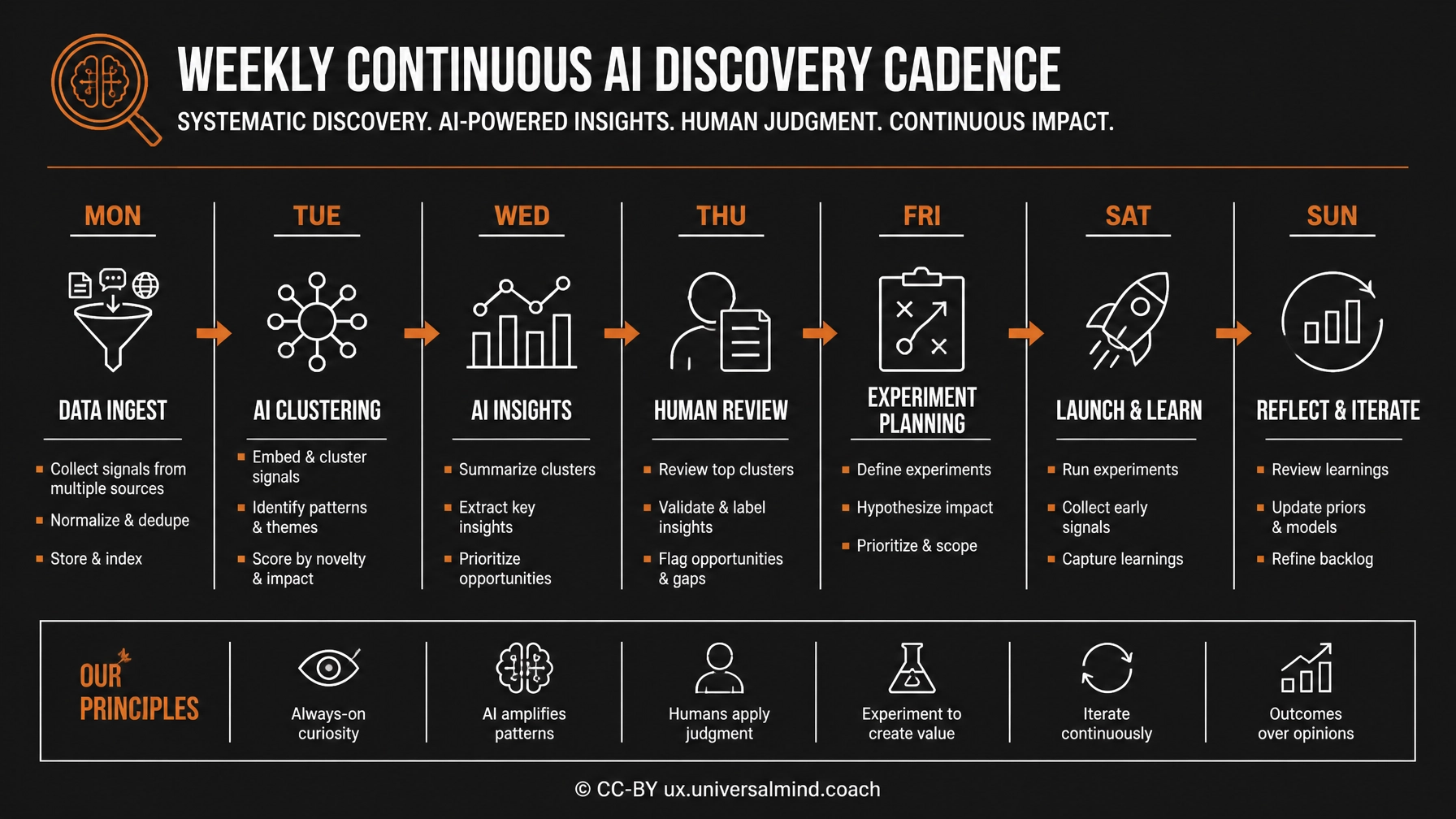
Key actions for your hub:
- Unify Formats: Ensure all qualitative data is transcribed and stored in a text-based format that LLMs can process.
- Capture Metadata: Always include the date, user segment, and source for every entry. Without this, your AI cannot track shifts in sentiment over time.
- Automate Ingest: Use tools like Zapier or Make to pipe support tickets and NPS comments directly into your repository.
Step 2: Automating the Synthesis Pipeline
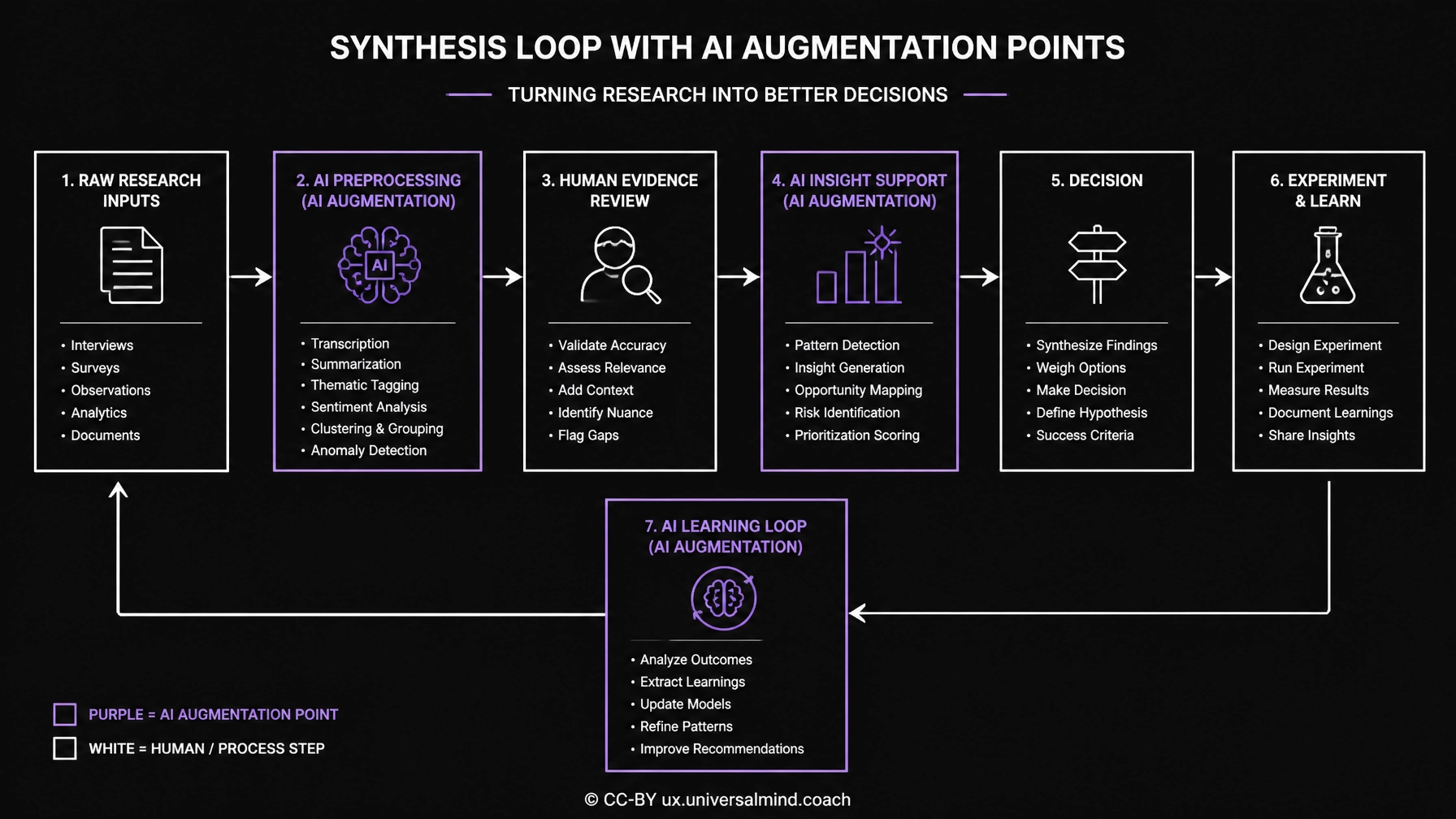
Once your data is flowing into a central hub, you can set up automated synthesis. The goal here is not to replace your analysis but to "preprocess" the data so you are never starting from a blank page.
You can instruct an AI agent to run a weekly "sweep" of your incoming data. It should perform three primary tasks:
- Auto-Tagging: Identifying key features, pain points, and sentiment mentioned in the text.
- Clustering: Grouping related feedback into "Themes" or "Opportunities."
- Flagging: Highlighting entries that contradict existing assumptions or show a significant shift in volume.
This creates a "Living Opportunity Map": a dynamic view of user needs that updates as new evidence arrives.
Step 3: Establishing the Sensemaking Cadence
Automation is useless if no one is looking at the output. Continuous AI discovery requires a rhythm of human-led "sensemaking loops." These are short, scheduled rituals where the product team reviews the AI-synthesised data and makes decisions.
The Weekly 20-Minute Loop
The team meets to review the top three shifts the AI detected over the past seven days.
- Review the Summary: Read the AI’s summary of new themes.
- Check the Evidence: This is crucial. Choose one theme and read at least one full, raw transcript related to it. Never rely solely on the summary.
- Determine a Bet: Based on the evidence, decide on one small experiment or "bet" for the following week — this could be a copy change or a micro-flow adjustment.
The Monthly Strategy Review
Once a month, zoom out. Look at your Opportunity Map and see which themes are growing fastest. Use this to reprioritise your roadmap, explicitly separating "learning bets" (research) from "shipping bets" (delivery).
Step 4: Maintaining Evidence Integrity
One of the greatest risks of AI-supported research is the "flattening" of insights. AI tends to smooth over the messy contradictions of human behaviour. To keep your research rigorous, you must enforce three rules for every AI-generated insight:
- The Denominator Rule: Always ask, "Out of how many?" If the AI says "Users are frustrated with the checkout," you need to know if that is 3 users out of 10 or 30 out of 3,000.
- The Verbatim Rule: Every insight must be linked to at least three raw, timestamped quotes. If the AI cannot provide the source, the insight is discarded.
- The Contradiction Rule: Explicitly prompt your AI to find conflicting signals. For example: "Identify three users who love the new navigation and three who hate it."
Step 5: Moving from Insight to Experiment
The final step in a continuous AI discovery guide is bridging the gap between discovery and delivery. Because discovery is continuous, your experiments should be too.
When a theme crosses a certain threshold (e.g., a 20% increase in mentions), it should automatically trigger a "Discovery Ticket" in your project management tool. Use AI to help frame the hypothesis for this ticket:
"Based on the recent cluster of feedback regarding onboarding friction (Source: 12 interviews this week), we believe that [Change] will result in [Outcome]. We will know this is true when we see [Metric]."
This ensures that your product decisions are always tethered to current, real-world evidence.
The Synthesis Flywheel (Original Framework)
To help you visualise this process, I use a framework I call the Synthesis Flywheel. It is a self-reinforcing loop that keeps your product grounded in reality.
- Capture: Real-time data ingest into the Hub.
- Synthesise: AI clustering and evidence linking.
- Sensemake: Weekly human reviews of AI outputs.
- Experiment: Launching small learning bets.
- Refine: Feeding experiment results back into the Capture phase.
By following this flywheel, you reduce the time between "Learning" and "Doing" to nearly zero.
Getting Started with Continuous Discovery
Building a continuous discovery habit takes time, but you don’t need a massive team or a six-figure budget to start. You can begin by simply centralising your last ten interviews in a Notion database and running a clustering prompt.
If you are ready to implement this at scale, start with my 5-Day Sprint Kit. It is designed to help you run your first AI-supported discovery cycle in a single week and build the habits required for long-term continuous discovery.
Once you have the basics in place, the AI Customer Research Hub gives you a structured Notion workspace for centralising transcripts, tagging evidence, and keeping your research repository usable over time.
If you want the full workflow, prompts, and setup patterns, I offer a deep-dive course — Continuous Discovery with AI. It covers the exact prompts, Notion templates, and operating patterns I use in practice.
For ongoing support, you can continue inside The Research Lab community, where I share practical examples, resources, and applied AI research workflows. If your team needs a more tailored setup, consulting is available through UX Consulting and AI Education.
Continuous discovery is not a destination; it is a discipline. By augmenting your human intuition with AI-powered synthesis, you can stop guessing what your users want and start building what they actually need.
Resources & References
- AI-Assisted UX Research: The 5-Day Sprint Kit
- How to Conduct AI-Moderated Interviews
- Ethics in AI Research: A Practical Checklist
- Torres, T. (2021). Continuous Discovery Habits. Product Talk LLC.