AI customer research mistakes often stem from the temptation to treat large language models as a shortcut to human truth.
When you use AI to bypass the "messy" parts of discovery—like talking to real people or manually analysing complex emotions—you risk building a product strategy on a foundation of algorithmic hallucinations. To use AI effectively in your research workflow, you must treat it as a support tool for human craft, rather than a replacement for it.
In my work supporting product teams and solopreneurs, I have seen how the speed of generative AI can create a false sense of security. It is easy to generate a summary of twenty interviews in seconds, but if that summary misses the emotional nuance or relies on biased "synthetic" data, the resulting product decisions will be flawed. This guide explores the seven most common pitfalls in AI-supported discovery and provides practical methods to fix them.
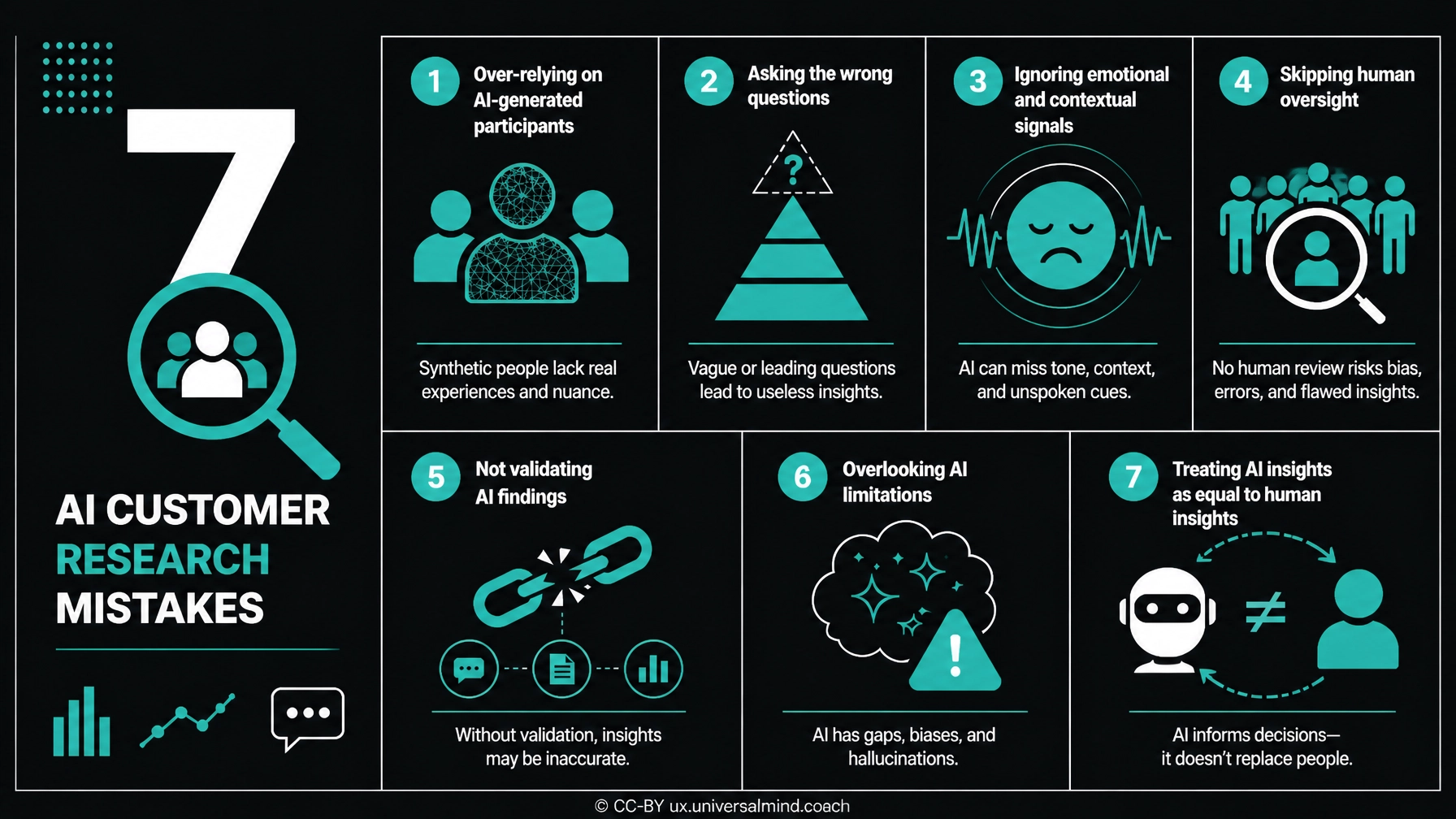
The seven AI customer research mistakes
1. Relying on Synthetic Users for Foundational Discovery
One of the most significant AI customer research mistakes is the attempt to replace real human participants with "synthetic users" or LLM-generated personas. While it is technically possible to ask an AI to "act like a 35-year-old software engineer in London," the response you get is simply a statistical average of the model's training data.
Synthetic users mirror existing patterns and stereotypes; they cannot give you the "aha!" moment of a real customer describing a unique workaround or a specific pain point you hadn't considered. If your discovery phase relies on these simulations, you are effectively researching a mirror of the past rather than the reality of your current market.
The Fix: Use AI to prepare for interviews—generating moderation guides or testing your questions for bias—but always conduct the actual research with real human beings. Reserve synthetic personas for low-stakes tasks, like checking the readability of your copy, not for validating your value proposition.
2. Prompting for "Themes" Before "Evidence"
When researchers are under pressure, they often ask an AI to "find the top three themes" from a pile of interview transcripts. This is a mistake. Without a structured coding framework, the AI will default to the most frequent words rather than the most significant insights.
Asking for themes first leads to generic findings that lack depth. You lose the nuance of why a customer felt a certain way, or the specific context that made their feedback valuable.
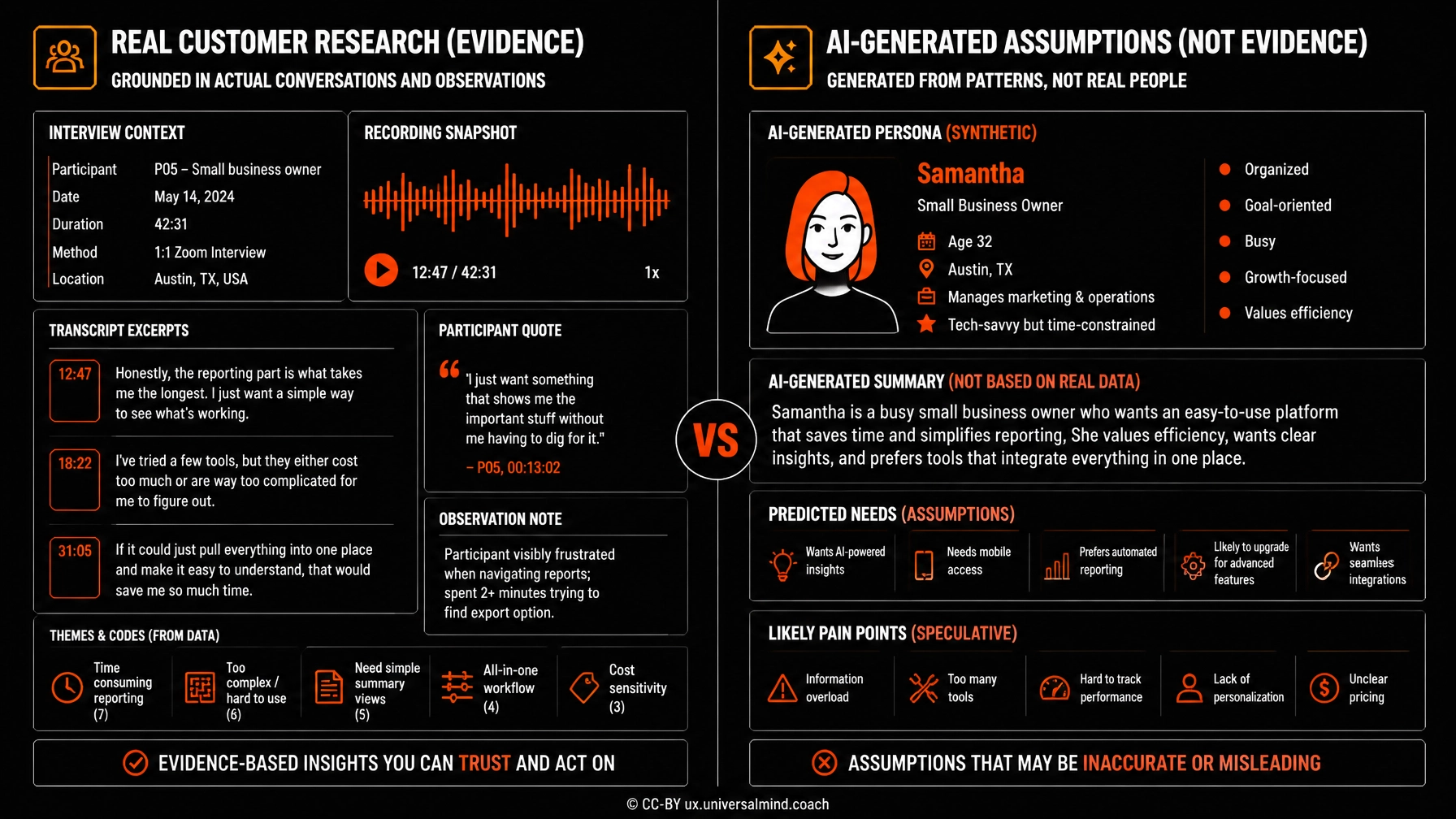
Grounded customer evidence vs. AI-generated assumptions
The Fix: Adopt a multi-step synthesis process.
First, ask the AI to identify specific observations or "codes" based on your research objectives. Only once you have a collection of evidence should you ask the AI to help group those observations into themes. This maintains a clear chain of custody from the raw data to the final insight.
3. Ignoring Emotional Intensity and "Silent Signals"
AI is excellent at summarising what was said, but it often struggles to quantify how it was said. A participant might mention a minor annoyance once and a critical, deal-breaking frustration once. To a basic LLM summary, these might look equal.
In customer research, the intensity of a problem often matters more than its frequency. If you ignore the emotional weight behind a participant's words, you may prioritise the wrong features on your roadmap.
The Fix: When using AI for analysis, specifically prompt the model to look for markers of emotional intensity—such as repetition, specific descriptive adjectives, or pauses. Better yet, use a tool like the AI Customer Research Hub to keep your original recordings and transcripts alongside your AI summaries, allowing you to jump back to the video to verify the "vibe" of the conversation.
4. Treating LLMs as Representative Demographic Experts
Many teams assume that because an AI has "read the internet," it understands the specific cultural and demographic nuances of their target audience. This leads to biased research outcomes.
LLMs carry the inherent biases of their training sets, which are often Western-centric and reflect certain socio-economic perspectives. If you ask an AI to analyse the needs of a demographic that is underrepresented in its training data, the insights will be at best superficial and at worst discriminatory.
The Fix: Be explicit about the context of your research in your prompts. Provide the AI with your own "ground truth" data—such as market reports or previous internal studies—to help anchor its analysis. Never assume the model’s default perspective is representative of your specific user base.
5. Disconnecting Analysis from the "Chain of Evidence"
A common error in the rush to produce reports is allowing the AI to generate a standalone list of insights that aren't linked back to the source transcripts. When a stakeholder asks, "Who said this?" and you can't point to the specific interview or timestamp, your credibility as a researcher is lost.
Without a traceable link to the original data, AI-generated insights become "opinionated summaries" rather than "evidence-based findings." This makes it impossible to audit the work or spot where the AI might have hallucinated a quote.
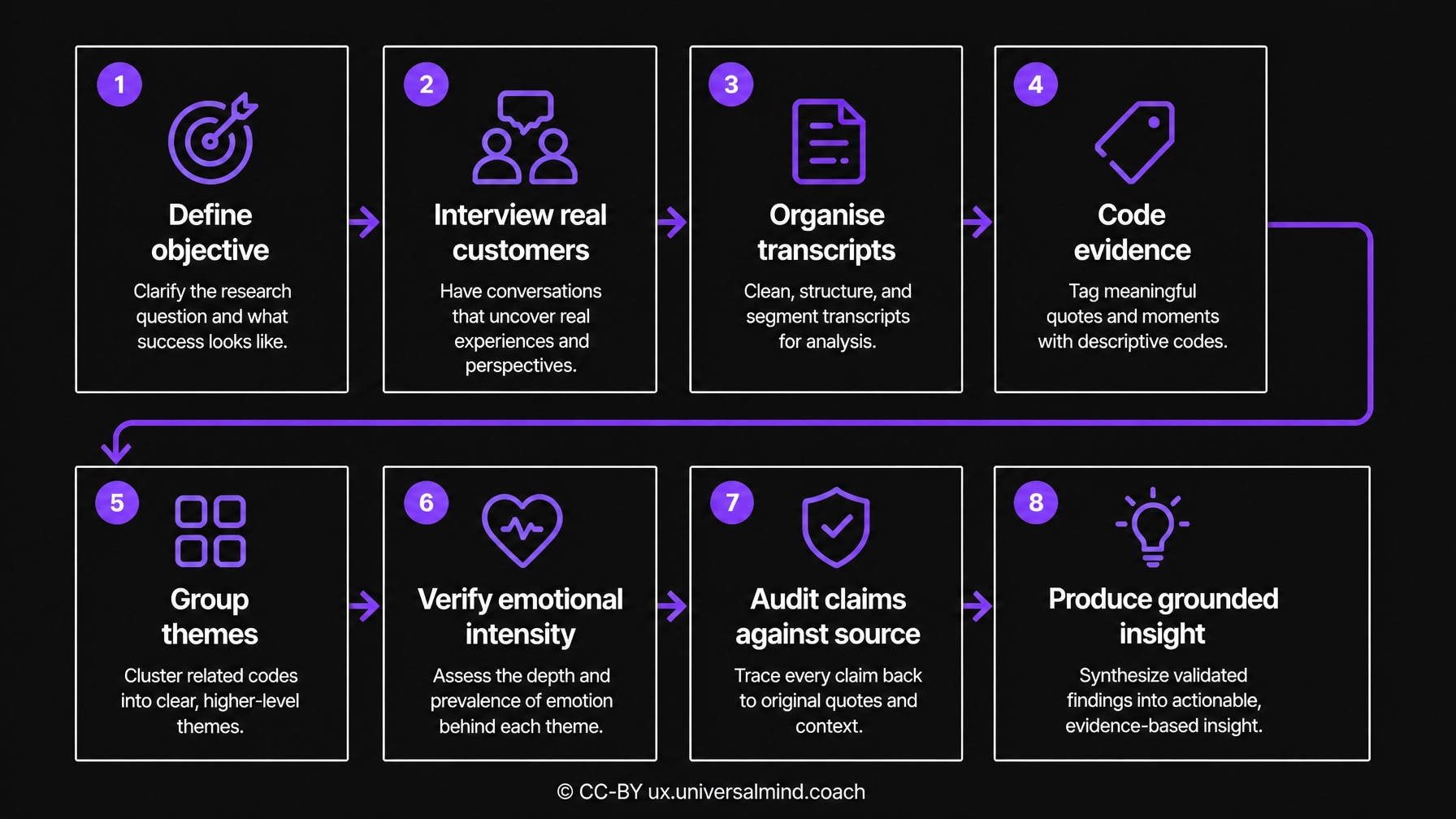
Fix workflow: from real interviews to grounded insight
The Fix: Organise your research in a structured workspace where every AI summary is intrinsically linked to its source.
My AI Customer Research Hub is designed exactly for this, ensuring that your insights always remain grounded in what was actually said by real people.
6. Neglecting the "Hallucination Check"
Even the most advanced models can occasionally "hallucinate"—creating facts, figures, or participant quotes that do not exist in the source material. In a 50-page synthesis report, these small errors can be hard to spot but can have a massive impact on product strategy.
Trusting AI output without a verification step is one of the most dangerous AI customer research mistakes. If you base a million-pound feature decision on a quote that the AI slightly misconstrued, the cost of that mistake is far higher than the time saved by using AI.
The Fix: Always audit a random sample of the AI's findings against the raw transcripts. Use "Chain of Thought" prompting—asking the AI to explain its reasoning and cite the specific line from the transcript for every claim it makes. If the AI cannot point to the source, the insight should be discarded.
7. Treating AI as the "Researcher" Rather than the Assistant
Perhaps the most fundamental mistake is the mindset that AI can "do" the research for you. Research is a strategic function that requires an understanding of business goals, technical constraints, and human empathy.
AI can augment your ability to process data, but it cannot decide which research questions are worth asking. It cannot navigate the politics of a stakeholder meeting or understand the long-term vision of your product.
The Fix: Reframe your relationship with the technology.
View AI as a "Research Ops" assistant that handles the heavy lifting of transcription, initial tagging, and formatting. This frees you up to do the high-value work—interpreting what the data means for your product's future.
Building a Rigorous AI Research Workflow
Correcting these AI customer research mistakes isn't about working harder; it’s about working with more rigour. By keeping the human at the centre of the process and using AI as a cognitive lever, you can run faster discovery cycles without sacrificing the quality of your insights.
If you are looking for a way to organise this process without the "AInxiety" of a fragmented tool stack, I recommend starting with a structured framework. My AI Customer Research Hub provides the database structure, prompt templates, and ethical guardrails you need to integrate AI into your workflow safely.
For those who want to go deeper into the technical "how-to" of these methods, you might find my Udemy course on AI & ChatGPT for UX Research helpful. It covers how to write the specific prompts that avoid the pitfalls mentioned above.
Remember, the goal is not to have the most AI in your research; it’s to have the most insight. Keep your evidence grounded, your analysis audited, and your focus on real human behaviour.
Ready to sharpen your research practice?
- Start with the free framework: Get the 5-Day Sprint Kit for a practical starting point.
- Organise your insights: Get the AI Customer Research Hub to manage your discovery in Notion.
- Master the tools: Learn my exact prompting frameworks in the AI & ChatGPT for UX Research and Continuous Discovery with AI courses.
- Join the community: Join the waitlist for The Research Lab, our community for researchers and product people.
- Need hands-on support? Explore consulting if you want a more tailored approach.